


Fat reduction and skin tightening are not the same thing. Non-surgical fat-reduction treatments are primarily designed to reduce localised fat or body circumference, while skin-tightening treatments target laxity, firmness, and changes in the skin’s supporting structures.
The distinction matters because an area that appears soft, loose, or poorly defined may be caused by excess fat, skin laxity, reduced muscle tone, or a combination of factors. Choosing the right treatment therefore starts with understanding what is actually contributing to the concern.
This guide explains the difference between non-surgical fat reduction and skin tightening, how the technologies work, and why one treatment cannot necessarily replace the other.
What Is Non-Surgical Fat Reduction?
Non-surgical fat reduction, sometimes described as non-invasive body contouring, refers to treatments designed to reduce the appearance or volume of localised fat without surgical procedures such as liposuction.
There are several approaches to non-surgical body contouring. Depending on the technology, treatments may use controlled cooling, heat, ultrasound, or low-level light.
The US Food and Drug Administration’s guidance on non-invasive body contouring explains that these procedures can be used for objectives such as changing the circumference of an area or reducing the appearance of small areas of fat. It also makes an important distinction: non-invasive body contouring is not a treatment for obesity and should not be confused with weight loss.
How Does Emerald Laser Fit Into Fat Reduction?
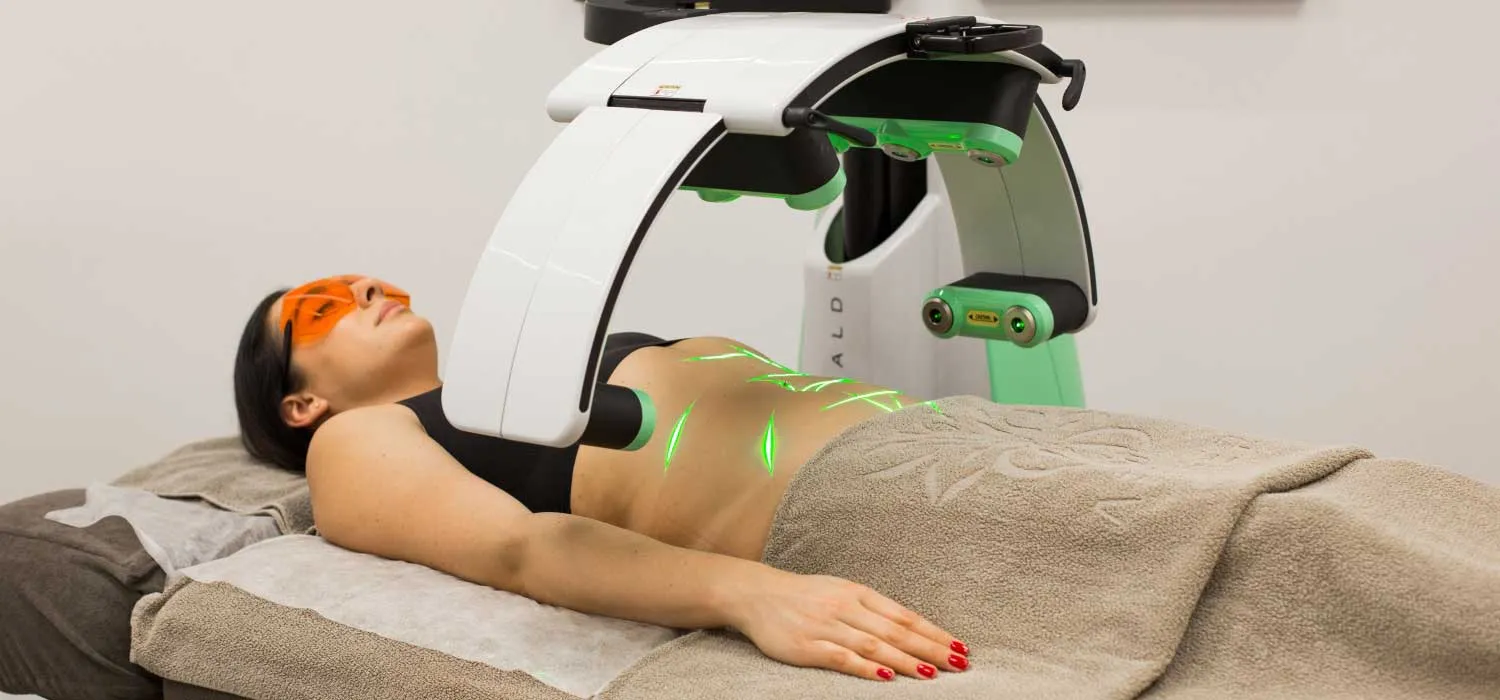
Emerald Laser is a non-thermal, low-level laser system designed for non-invasive body circumference reduction.
Unlike technologies that intentionally heat or freeze tissue, Emerald uses low-level green laser light. The FDA’s 510(k) documentation describes the Emerald device as a low-level laser system using visible green light between approximately 522 and 542 nm.
Emerald has FDA clearance as a non-invasive dermatological aesthetic treatment for the reduction of body circumference in individuals with a BMI of up to 40 kg/m². Its regulatory indication is therefore centred on circumference reduction rather than weight loss or treatment of obesity. You can view the FDA’s official Emerald Laser 510(k) record for further information.
This distinction is important when setting realistic expectations. Emerald is primarily a body-contouring and circumference-reduction treatment; it should not automatically be assumed to correct significant loose skin.
What Is Skin Tightening?
Skin-tightening treatments address a different component of appearance: skin laxity and reduced firmness.
Collagen and other structural components of the skin change with age. Skin quality may also be influenced by genetics, sun exposure, pregnancy, changes in body weight, smoking, hormonal factors, and the natural ageing process.
Someone can therefore have relatively little excess fat but still notice:
- Loose or crepey skin
- Reduced firmness
- Less defined facial or body contours
- Skin laxity following weight change
- Age-related loss of elasticity
Non-surgical skin-tightening treatments may use technologies including radiofrequency, ultrasound, radiofrequency microneedling, and certain laser or light-based systems.
The objective is different from fat reduction. Instead of principally targeting unwanted volume, these technologies are generally designed to create controlled effects within the skin or supporting tissues that can stimulate processes associated with collagen remodelling.
A recent systematic review of radiofrequency treatments for facial rejuvenation found improvements in outcomes including skin firmness and texture across the studies reviewed, while also highlighting variation in study methods and the need for stronger standardised evidence.
Fat Reduction vs Skin Tightening at a Glance
| Comparison | Fat Reduction | Skin Tightening |
|---|---|---|
| Primary concern | Localised fat or excess circumference | Loose or less firm skin |
| Primary target | Adipose tissue / body circumference | Skin and supporting tissue |
| Typical goal | Reduce unwanted volume or circumference | Improve firmness and the appearance of laxity |
| Example technology | Emerald low-level laser | Radiofrequency treatments such as XERF |
| Does one replace the other? | Not necessarily | Not necessarily |
How Can You Tell Whether Fat or Loose Skin Is the Main Concern?
This is not always straightforward from appearance alone.
For example, fullness around the abdomen may primarily reflect localised fat, while a similar-looking concern in another person may be strongly influenced by reduced skin elasticity following pregnancy or substantial weight change.
A poorly defined jawline can similarly be influenced by several factors, including:
- Submental fat beneath the chin
- Skin laxity
- Facial volume changes
- Muscle and soft-tissue anatomy
- Age-related structural changes
This is why treatment selection should ideally be based on assessment rather than simply choosing a device according to the body area involved.
Does Fat Reduction Automatically Tighten Loose Skin?
No. Reducing fat does not necessarily mean that loose skin will tighten.
Fat and skin are different tissues, and the technologies used to address them may have different biological targets.
Someone with good baseline skin elasticity may find that their skin adapts well as their contours change. Another person with established laxity may continue to have loose skin despite reducing unwanted volume.
In some circumstances, reducing underlying volume may even make existing laxity easier to see. That does not necessarily mean the fat-reduction treatment has failed; it can mean that both unwanted fat and reduced skin elasticity were contributing to the original concern.
What If Loose Skin Is the Main Concern?
Where the principal concern is skin laxity rather than excess fat, a treatment specifically designed around skin tightening may be more appropriate.
Radiofrequency is one technology used for this purpose. Controlled RF energy generates heat within targeted tissue, with research supporting mechanisms involving collagen contraction and remodelling.
One newer example is XERF, a non-invasive monopolar radiofrequency technology combining 6.78 MHz and 2 MHz frequencies with different treatment-depth settings.
For patients specifically researching treatment in the capital, Dr Nyla Medispa provides further information about XERF skin tightening in London, including how the treatment is used for patients concerned about reduced firmness and skin laxity.
The important distinction is that XERF and Emerald Laser are not competing versions of the same treatment.
Emerald is primarily used for non-invasive body circumference reduction, whereas XERF is a radiofrequency technology used for skin tightening. Which approach is more appropriate therefore depends largely on the underlying concern.
What If You Have Both Unwanted Fat and Loose Skin?
It is entirely possible to have both.
For example, someone may have localised abdominal fat alongside reduced skin elasticity following pregnancy or changes in body weight. Similarly, fullness beneath the chin may exist alongside reduced firmness around the jawline and neck.
In these circumstances, it can be useful to separate the concern into its individual components rather than expecting one device to address everything.
An appropriate assessment may consider:
- The amount and distribution of localised fat
- Skin quality and elasticity
- The degree of laxity
- The area being treated
- Previous changes in body weight
- Age and relevant medical history
- Previous aesthetic treatments
- The individual’s expectations and desired outcome
Where more than one factor is involved, different technologies may sometimes be considered for different treatment goals. This does not mean that every patient requires combination treatment; the appropriate approach should be determined individually.
Can Non-Surgical Treatments Replace Surgery?
Not in every case.
Non-invasive treatments are generally aimed at people seeking improvements without surgery, but their capabilities have limits.
Someone with a relatively small area of unwanted fat may be very different from someone with substantial excess skin following significant weight loss. Pronounced skin excess cannot simply be assumed to respond adequately to an energy-based tightening treatment.
Likewise, non-invasive body contouring should not be regarded as an alternative to medically appropriate weight-management treatment where obesity or broader health concerns are the primary issue.
A trustworthy treatment plan therefore includes explaining when a non-surgical procedure is unlikely to achieve the patient’s desired result.
Why Treatment Assessment Matters
The most important question is not simply “Which treatment is better?”
It is:
“What is actually causing the concern we are trying to treat?”
If excess fat is the predominant issue, body-contouring technologies designed around circumference reduction may be considered.
If laxity and reduced skin firmness are the predominant concerns, dedicated skin-tightening technologies may be more logical.
If both are present, the practitioner should identify each component and explain realistically what can and cannot be achieved.
Treatment suitability can also depend on medical history, medications, implanted devices, pregnancy, skin condition, previous procedures, and other individual factors. A consultation should therefore form part of responsible treatment planning.
Frequently Asked Questions
Is fat reduction the same as weight loss?
No. Non-surgical body contouring is intended to change localised contours or circumference rather than produce generalised weight loss. The FDA specifically states that non-invasive body contouring is not a treatment for obesity and does not provide the health benefits associated with weight loss.
Does Emerald Laser tighten skin?
Emerald Laser’s FDA-cleared indication is for non-invasive body circumference reduction. It should therefore primarily be considered a body-contouring technology rather than a dedicated skin-tightening treatment.
What treatment is used when loose skin is the main concern?
Several technologies are used for non-surgical skin tightening, including radiofrequency and ultrasound-based treatments. The appropriate technology depends on factors such as the treatment area, degree of laxity, skin quality, anatomy, medical history, and expected outcome.
Can you have fat reduction and skin tightening treatments?
Potentially, because the treatments can address different concerns. However, this does not mean that combination treatment is appropriate or necessary for everyone. Treatment planning should be based on individual assessment.
Can non-surgical skin tightening remove significant excess skin?
No non-surgical treatment should be assumed to reproduce the results of surgical skin removal. Where there is substantial excess or hanging skin, particularly following major weight loss, surgical assessment may be more appropriate.
Fat Reduction vs Skin Tightening: The Bottom Line
Fat reduction and skin tightening solve different problems.
Emerald Laser is a non-thermal, low-level laser technology with FDA clearance for non-invasive body circumference reduction in individuals with a BMI of up to 40 kg/m².
Skin-tightening treatments instead focus primarily on laxity, firmness, and changes within the skin and supporting tissues. Technologies such as radiofrequency work through a fundamentally different mechanism and should not simply be considered interchangeable with fat-reduction treatments.
For some people, unwanted fat is clearly the predominant concern. For others, skin laxity is more important. Some people have both.
Identifying that difference through appropriate assessment is one of the most important steps in selecting a non-surgical body-contouring or skin-tightening treatment and setting realistic expectations about what it can achieve.
